|
Galileo Controller
- the most advanced and reliable irrigation & climate control
equipment in the market!
Galileo
is a computerized agricultural control system, among the most advanced
in its field, for climate control and irrigation in green houses and
irrigation control of large open fields, farms, orchards, turf, public
gardens and more.
The Galileo W models include input/outputs slots in which the I/O cards
can be fitted.
The available Galileo W models are:
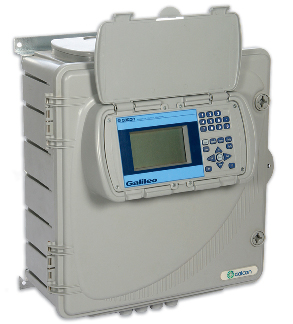
Galileo W
a modular controller in the advanced "small casing"(4 slots).
Galileo WEX
a modular controller in the advanced "large casing"(4 I/O slots and 4
protection slots).
Galileo WEXX
a modular controller in the advanced "large casing"(8 I/O slots, 4
protection slots,
L-485 slot). For full protection a small casing is added.
AC Models
All of the models include:
• Power Supply - 24 VAC
• Output Voltages - 24 VAC
• Discrete Inputs - On/Off
• Analog Inputs - 4-20 mA
AC I/O Cards
Each I/O cards can be fitted in any of the controller's slots.
• 8 Inputs/16 outputs - serves as a basic unit (is included in the price
of the controller)
• 24 Outputs
• 16 Analogs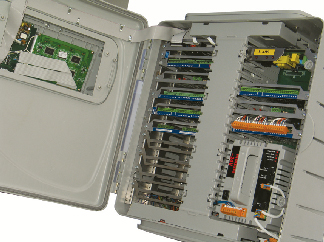
• Wire RTU Adapter - see more in the following RTU chapter
• One way Radio RTU adapter
• Two way Radio RTU adapter
DC Models
• Power Supply: 12 VDC
• Consumption: 150 mA approx.(when the display is switched off)
• Outputs: 12 VDC latching
• Discrete Inputs : On/Off
• Analog inputs: 4-20 mA
DC I/O Cards
• 8 inputs/8 outputs
• 16 analogs
• Wire RTU Adapter
• One way RTU Adapter
• Two Way RTU Adapter
Remote Terminal Units (RTU)
These are small units with several inputs and outputs, installed in the
field at a distance of a few km from the controller. The unit is
connected locally to the elements (solenoids, meters, sensors etc.), it
is constantly in communication with the controller receiving operational
command and transferring data back to the controller.
There are 3 types of RTU:
The system consists of a CRTU adapter inserted into the controller, a 3
wire single cable that can be up to 6 km long along which the CRTU units
are installed.
A combination of units with a total of up to 128 outputs can be
installed along the cable. Two such cables can be installed on one
controller.
There are two basic CRTU models
Cable RTU (CRTU)
The system consists of a CRTU adapter inserted into the controller, a 3
wire single cable that can be up to 6 km long along which the CRTU units
are installed. A combination of units with a total of up to 128 outputs
can be installed along the cable. Two such cables can be installed on
one controller.
• CRTU-2: 2 Outputs - 12 VDC latching; 4 Inputs (On/Off)
• CRTU-4: 4 Outputs - 12 VDC latching, 8 Inputs (On/Off),
4 Analogs - 4-20 mA or 0-10 V
Radio RTU AP (1 way RRTU)
This system transmits a radio signal from the controller to a distance
of up to 5 km (depending on the field conditions), the signal is
received by the radio RTU and can open or close outputs. (This unit does
not include inputs).
The system consists of:
• Serial Transmitter (SRT): includes: 1W-RRTU adapter (located inside
the controller), data cable, radio transceiver and an antenna.
• Field Units: includes:
• 2 or 4 12 VDC latching outputs
• A lithium battery, 3.6 VDC which lasts under field conditions up to
2-3 years.
• The unit is enclosed in 100% water proof, epoxy molded housing.
• Each unit is loaded with its own "private" code number using a
portable terminal.
Radio-Gal (2 way RRTU)
The controller is connected via radio to units that consist of outputs,
inputs and analogs. The controller scans the units in the field via
radio, transmitting the command to open or close outputs and receiving
the data from the inputs and analogs. During each scan cycle the
controller receives the number of pulses entered and the time (in
milliseconds) between the last two pulses thus assuring that pulses
can't be lost in the air. The system consists of:
• Transmitting Unit: That includes an interface card inside the
controller a radio transceiver and an antenna.
• Field Units: Each unit includes:
• Small transceiver
• Batteries: 2-8 x D size lithium 3.6V
• I/O: 4x outputs (2 or 3 wires), 2 input, 2 analogs
• Coding: by dip switch
Keyboard and Display Console
Identical in all Galileo models, consists of a wide 25 rows LCD display
and a 24 keys keyboard used for programming and data presentation. All
types of programming can be performed by the console.
The console can be installed in 3 positions in the controller casing (on
the front door or on the top or bottom of the casing).
Memory Backup
The RAM is backed up by a lithium battery, installed on the main board
that lasts for at least 5 years thus assuring that data is not lost even
in the event of power failure.
Communication Ports
• One RS-232 port output for communication with a remote PC.
• One RS-485 port for connection to an expansion unit or ECpH monitor.
Galileo - Central PC Computer
The advantages of connecting the controllers to a PC are:
• Remote Control:
Instead of working out in the field it is possible to carry out the same
tasks from the comforts of your air conditioned office.
• Central Command:
Several Galileos can be connected to one computer, allowing the control
of a very large area from a single location.
• Graphical Presentation:
It is possible to see an on-line presentation of the field showing all
active elements and the system status in an understandable, familiar
way.
• Data Acquisition:
The computer can collect a variety of types of data such as Valve
Accumulations, Water Meters, Water Meter Flow Rates, Irrigation
Information and more.
Many types of reports and graphs can be shown. The reports can be set
for ranges varying from a single hour up to a full year. Some of the
reports are highly specialized, for example a report of fertilizer
elements (nitrogen, phosphorus, potassium etc.) per valve.
The data can be exported to an Excel data sheet for further analysis.
Communication with the central computer:
• Direct connection - by cable up to 20 meters.
• Long distance cable by a special cable modem (L485), up to 4 Km
enabling controller networks.
• Cellular modem (including GPRS).
• Radio communication - range of up to 20 km. Extra range can be
achieved via repeaters.
Galileo - Software Description
Several types of software (applications) can run on the same previously
described hardware. The different application is selected according to
the type of project.
The available applications are:
• Open Field irrigation
• Green Houses
• Irrigation
• Climate
• Nursery irrigation
The Open Field Irrigation Application
This unique application is designed to provide a solution for a wide
variety of irrigation needs. It can be used in very small irrigation
systems such as a home garden or for the largest systems such as
irrigation communities. The system fully supports the use of cable and
radio RTU. The Open Field PC Software is graphic and allows the user to
draw a realistic picture of the field.
Setup Features
Pipe Lines & Main Valve (up to 70)
In this unique system each pipeline can be connected to another pipeline
thus enabling defining the pipelines as a network.
The pipelines can be set in the same way as they appear in the field.
This enables:
• Hierarchy
of main valves and head definition.
• Gradual
opening and closing of irrigation to prevent high pressure buildup.
• Flow rate
limit to a pipeline (in the case of bottle necks). Upon programming the
limiting flow rate, the system does not allow the actual flow rate to
exceed the limit by detaining irrigation programs when the flow rate is
already too high.
• Protection
of definition errors such as fertilizer pump not in route to the valve
using it.
Irrigation Valves (up to 200)
The valve features include accumulation data of water, time and up to 7
different fertilizers.
Water Meters (up to 100)
The water meters characteristics include the ability to divide the
amount and flow rate of water measured by the water meter between the
valves using it (according to the valves' nominal flow rates). It allows
using one water meter for many valves, whilst operating and accumulating
each valve separately.
Fertilizer System: there are two fertilizing elements
Local fertilizer pump (up to 30) using a simple operation program
(included in the irrigation program) and Fertilizer Center (up to 10)
that includes the operation of up to 6 fertilizer pumps, control of EC
and pH and more.
Pump Houses (up to 5)
A special program to control the operation of a combination of up to 5
water pumps.
Virtual Water Meters (up to 20)
An element that consists of up to 20 water meters. It shows the sum of
the flow rate and the accumulation of water meters. The virtual water
meter can also show the balance of the flow rate at a certain point
allowing the use of the element called Burst Control (Net Protection).
Pause Element (up to 10)
An element which contains a condition input and/or a sensor (such as
pressure transducer) and can pause the pipe line it is connected to, as
a condition of the input/sensor status.
Mixing Junction (up to 5)
A program that controls the dilution of water such as drainage water
with fresh water, according to the EC of the resulting mixture.
Irrigation programs (up to 200)
Each irrigation program includes:
• Up to 50 valves for operation
• Quantity or duration
• Local Fert. Pump
• Selection of Fert. Program of fertilizer center
• Over/under flow alarms
• Sequential operation
• Start and stop time
• Cyclic irrigation
• Daily (days of the week)
• Conditioned irrigation
• Many other options
The Green House Application
This application combines an irrigation system and up to 4 climate
control systems in the same controller.
Green House Irrigation System
The system is composed of one irrigation head in which a fertilizer
center performs sophisticated fertilizer injection of up to 8 different
fertilizers whilst carrying out the essential control of conductivity
and acidity of the irrigation water.
Galcon produces three type of machines suited to this application:
Green House Irrigation Capabilities
The following elements can be operated by the irrigation system:
• One irrigation head including: main valve, water pump, main fert, etc.
• Up to 100 valves
• Up to 8 fertilizer pumps
• Up to 5 fert. selectors
• Up to 10 filters
• Up to 20 drainage sampling outputs
• Up to 40 misting valves
• Additional elements
The following elements can be read by the irrigation system
• One water meter
• 8 fertilizer meters
• Up to 100 sensors
• Special mixer Inputs
• Special mixing and recycling inputs.
Programming Features:
• Up to 100 irrigation program can be set, each containing:
• Up to 4 valves directly and 16 valves. indirectly worked by a single
program.
• Preset fertilizer programs: Up to 50 different fertilizer programs in
which the proportion of fertilizer/water for each fertilizer pump is set
along with the EC/pH requirement.
• The time range for operation.
• Up to 5 hourly start times per day.
• Cyclic irrigation.
• Several options of manual overriding.
• Misting programs:
Up to 40 foggers with a fogging program each containing:
• Time of operation.
• Time of cycle that can be altered by the conditions of temperature,
humidity and other conditions.
• The use of logical conditions for operation.
• Sequential operation.
• Drainage Sampling: Up to 20 sampling points can be connected to the
controller via a device called "Dagan". It measures the quantity, EC and
pH automatically and corrects the next irrigation properties
• Filter Flushing: Up to 10 filters divided between up to 2 stations can
be programmed.
Green house Climate Control
The system includes a large diversified and flexible software package
that can be fitted to the use of almost any farmer without any special
modifications.
Climate System Sensors
• Internal Sensors
in the greenhouse includes: temperature, humidity, CO2 and more.
•
External Sensors
includes: wind velocity and direction, radiation, rain meter, external
temperature and humidity and more.
• The normal temperature, humidity and radiation are carried out by a
central program of requirements according to the day segmentation. The
day (24 hours) can be divided into up to 8 segments each having required
temperature, humidity and radiation. The control is carried out
(according to the element setup) to maintain the required condition
throughout the day.
On the basis of the above sensors the system operates the greenhouse
components.
Up to 4 greenhouses climate controlled systems can be setup each
containing
Windows
(Curtains) (up to 10 - including roof windows): Each of the windows can
open up in 10 stages according to temperature, humidity, wind, rain,
logic conditions and processes such as CO2 and spraying.
Fans (up to 4)
Refers to the fans installed on the side wall of the greenhouse and
exhaust the air outside the green house letting fresh air into the green
house from the opposite wall. Up to 4 groups of fans can be controlled
per greenhouse. The fans can be programmed to work according to the
conditions mentioned for the windows along with cyclic programs that can
change the cycle automatically according to the temperature. The fans
can be dependent on other process in the same way as the windows.
Thermal Screens (up to 4)
An element in the greenhouse that can be spread or rolled up according
to the level of the radiation and/or the temperature.
Up to 4 opening stages can be setup.
Cooling System (up to 4)
The cooling system is either wet pads or fogging systems. It can be
operated according to the temperature, humidity or other conditions. The
process of cooling includes in many cases operation of other elements
such as fans in the case of cooling pads.
Heating System (up to 4)
The methods of heating the greenhouse are either hot water heating or
air heating. The heating system is normally programmed to maintain a
certain air temperature by starting and stopping the heating output.
When greater accuracy is required or in more severe conditions a special
program of "Circulating Heating" is available, allowing PID control of
the water temperature, according to the air temperature and the heating
conductivity data of the greenhouse. Heating can be dependant on
humidity and other conditions.
CO2 Enrichment (up to 4)
A program controlling the operation of the CO2 valve.
The process of CO2 may include some other elements such as windows, air
circulating etc.
Spraying (up to 4)
This system usually includes a special device that emits pesticide spray
in a certain location in the greenhouse. The process includes closing
windows and operating the air circulating in order to ensure that the
pesticide reaches all points of the greenhouse.
Air Circulating (up to 6)
Refers to fans installed inside the greenhouse that cause air
circulation inside the greenhouse. The programs of these elements
include cyclic operation according to temperature, humidity and
processes such as spraying, CO2 and many others. This same element can
be used also for lighting and others.
Galileo - Alarm Activation
Activated in the case of system failure such as over/under flow rate,
uncontrolled water, missing water
meter pulse and extreme climate conditions.
Alarms can be issued via an external device such a siren or a flashing
light. They can also be sent as an S.M.S text message to a cellular
phone or as an email. |